
Complaints & Feedback Policy
| Policy area | Service Delivery |
| Applicable to | SK Dhaliwal Pty Ltd |
| Version | V1.0 |
| Date approved | 22 June 2025 |
| Approved by | Director |
| Review date | 22June 2026 |
| Authority | NDIS Act 2013 NDIS Practice Standards and Quality Indicators NDIS Code of Conduct NDIS (Complaints Management and Resolution) Rules 2018 NDIS (Procedural Fairness) Guidelines 2018 UN Convention on the Rights of Persons with Disabilities UN Convention on the Rights of the Child Aged Care Act 1997 Aged Care Quality and Safety Standards Aged Care Code of Conduct Privacy Act 1988 |
PURPOSE
The purpose of this policy and procedure is to explain our organisation’s commitment and approach to client feedback and complaints management.
SCOPE
This policy and procedure applies to all our workers (employees, contractors and volunteers).
DEFINITIONS
| Term | Definition |
|---|---|
| Complaint | Expressing dissatisfaction with a support or service where standards or expectations have not been met. |
| Open Disclosure | The practice of acknowledging the complaint, expressing regret to the person making the complaint that standards or expectations have not been met, finding out what happened, how and why and seeking to learn from the experience and make improvements. Note: Expressing regret does not mean an admission of guilt. |
| Procedural Fairness (‘Natural Justice’) | Legal term for acting fairly in administrative decision-making. |
| Reprisal | The act of retaliation — to ‘pay back’ someone who has actually or allegedly ‘wronged’ you. |
| Retribution | The act of taking revenge — punishment inflicted motivated by personal vengeance. |
CONTEXT
Our organisation recognises the importance of an effective feedback and complaints management system to provide our clients with safe and quality care and continually improve our service delivery and business operations. We will maintain a feedback and complaints management system that:
- is proportionate to the size and scale of our organisation and the scope and complexity of supports provided;
- complies with relevant legislation, regulations, standards and principles — including principles of procedural fairness (‘natural justice’).
- is fair, consistent and transparent;
- upholds clients’ human rights — including their right to privacy, confidentiality, dignity and respect;
- promotes clients’ right to choice, control and self-determination;
- encourages and supports client independence and capacity-building, where possible;
- provides cultural and language-accessible modes and methods for clients to submit feedback and complaints; and
- fosters a resolution-based culture of open disclosure without discrimination, reprisal or retribution.
POLICY STATEMENT
1. Encouraging and Acknowledging Feedback, Compliments and Complaints
- We will ensure clients are aware of their right to provide feedback and make a complaint (without fear of reprisal or retribution), both internally in our organisation and also externally to a regulator, and support them to do this if requested.
- We will welcome all complaints, concerns, compliments and suggestions and view them as opportunities for continuous improvement.
- We will support clients to access an advocate, language services or any other aid or service they need to raise and resolve a complaint.
- We will acknowledge the complaint verbally and/or in writing, expressing regret that standards or expectations have not been met, or express verbal gratitude to acknowledge a compliment, in a way that is culturally respectful, and in a language, mode and method the client is most likely to understand.
2. Response Actions
- We will take required action(s) to address immediate client risks, issues or concerns.
- We will conduct internal and external incident reporting as required.
- We will document the feedback/complaint in the Complaints Register.
- We will discuss our response actions with the client and/or family/alternate decision-maker/advocate and encourage their involvement in improving our services.
- We will inform the client if their rights or interests may be adversely affected in a direct and specific way because of the complaint, or something relating to the complaint.
- We will ensure any adverse decision outcome(s) for the client is/are based on the facts and the record of decision is clearly and accurately documented in the client file and in the Complaints Register.
3. Communication and Collaboration
- We will conduct all discussions with the client and/or family/alternate decision-make/advocate with sensitivity, courtesy and respect.
- We will communicate and collaborate with the client and/or family/alternate decision-maker/advocate throughout the complaints process.
4. Continuous Improvement and Quality Management
- We will seek to learn from feedback and complaints and continually improve our service delivery processes.
- We will review and analyse feedback and complaints raised to identify systemic issues and take follow up action(s) as required (changes to policy and procedures, worker rostering, supervision and training, technology and communications).
- We will report outcomes of complaints/incident investigations to both the client and other stakeholders (including relevant workers) and ensure this is documented in our quality management system as part of the continuous improvement process.
- We will regularly review and improve the effectiveness of our feedback and complaints management system.
5. Reviewing and Monitoring Processes
- 5. Reviewing and Monitoring Processes
- We will maintain a Complaints Register and a Continuous Improvement Register with details, actions and outcomes of complaints and suggested improvements.
6. Information and Record-keeping
- We will ensure information and records are accurate and up to date.
- We will ensure the client has provided us with all required written consents.
- We will store the information securely to ensure privacy, dignity and confidentiality and make sure it is accessible to the client and only other stakeholders authorised to access it.
7. Worker Training and Supervision
- We will maintain a skilled and trained workforce, which is aware of clients’ right to complain and our complaints-handling process.
- We will maintain processes to adequately monitor and supervise workers.
PROCEDURES
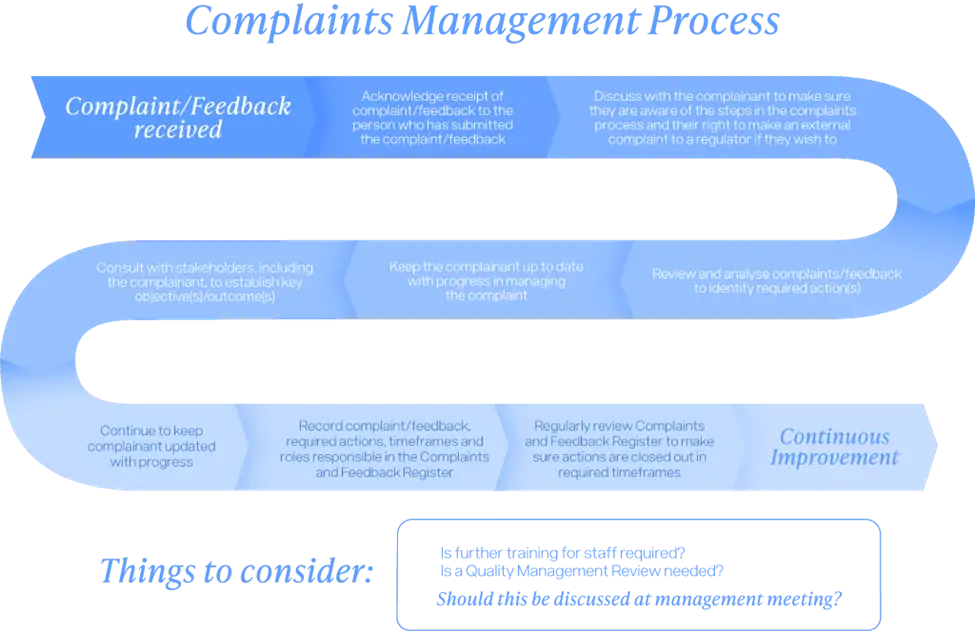
Following are the key steps in the complaints management process. Refer to Appendix 1 at the end of this document for a graphical representation of the process steps.
1. Lodging a Complaint
- Discuss with the client and/or family/alternate decision-maker/advocate their right to make either an internal or external complaint. Provide information about the complaints management process: at intake and in the client Welcome Pack; in the Service Agreement; during support provision; and during client reviews and assessments.
- Encourage the client to complete the Complaints and Feedback Form to lodge a complaint. If it is easier for them, they can write it down on paper, send it via email, or tell you and you can fill out the Form.
- Assist the client with lodging an external complaint to the NDIS Commission or the Aged Care Quality and Safety Commission, or other regulators such as the Human Rights Commission or Office of the Australian Information Commissioner, if requested. Refer to Appendix 2 for regulator contact details.
2. First Actions
- Develop a written acknowledgment of feedback/complaint which: is sincere in concern about the client’s health, safety and wellbeing; is specific and direct; provides relevant information and explanation about next actions; and provides contact details and encourages the client to make contact if they have concerns or want information.
- Where possible, resolve the complaint at the point of service, unless further investigation is required.
- Do not discuss the complaint with anyone who does not have responsibility for resolving the issue.
- Provide the client with any cultural, communication or language aids or support they need (language interpreter or Auslan interpreter, pictorial information).
- Assist the client with engaging an advocate or informal support (family member, friend, community Elder) if requested.
- Make sure the client continues to feel respected, safe and supported throughout this process.
3. Point-of-Service (No Investigation) Complaint Process
- Check on the client’s health and wellbeing.
- Escalate the complaint to Director for review and further action(s) (this role will perform steps in 3.3-3.6 below).
- Gather all information and data (including witness accounts etc) as required.
- Establish what type of outcome the client seeks (e.g. acknowledgment, answers, actions, apology).
- Reach a decision/compromise acceptable to the client and all other parties.
- Thank the client for the feedback and their time, take any required actions and communicate actions and outcome to all relevant stakeholders.
4. Not Resolved at Point of Service (Investigation Required) Complaint Process
- Check on the client’s health and wellbeing.
- Escalate the complaint to Director for review and further action(s) (this role will perform steps in 4.3-4.9 below).
- Gather all information and data (including witness accounts etc) as required.
- Ensure there is a safe and comfortable environment for investigation meeting(s) to take place and the client feels respected and supported.
- Ensure the client’s advocate is present at investigation meetings if requested/required.
- Establish what type of outcome the client seeks (e.g. acknowledgment, answers, actions, apology). This will inform the investigation process.
- Keep communicating with the client and/or family/alternate decision-maker/advocate throughout the complaint process.
- If a compromise/solution/decision has been reached, communicate with the client and other stakeholders and conduct any required actions.
- If a compromise/solution/decision cannot be reached, contact external complaints mechanisms as required. Refer to Appendix 1.
5. Documenting Details, Actions and Outcomes
- Input details of complaint and the relevant actions and outcomes in the relevant register (Complaints Register, Compliments Register and Continuous Improvement Register).
- Document information in the Support Plan and other relevant documents as required.
- Action continuous improvement items and conduct ongoing review and monitoring.
SUPPORTING DOCUMENTS
- Anonymous Complaints and Feedback Form
- Complaints and Feedback Form
- Complaint Investigation Form
- Complaints, Compliments and Feedback Register
RESPONSIBILITIES
Director is responsible for:
- maintaining this policy, its related procedures and associated documents;
- ensuring the policy and procedure is effectively implemented across the service;
- monitoring workers compliance with the requirements of this policy and procedure; and
- ensuring training and information is provided to workers to carry out this policy and procedure.
All workers are responsible for complying with the requirements of this policy and procedure.
COMPLIANCE
Deliberate breaches of this policy and procedure will be dealt with under our misconduct provisions, as stated in the Code of Conduct Agreement.
Appendix 1: Complaints Management Process
Deliberate breaches of this policy and procedure will be dealt with under our misconduct provisions, as stated in the Code of Conduct Agreement.
Schedule 2: Complaints and Feedback Contact Information
| Regulator | Complaints and Feedback Contact Information |
|---|---|
| NDIS Commission | Phone: 1800 035 544 (free call from landlines) or TTY 133 677 National Relay Service and ask for 1800 035 544 Complete an online complaint contact form |
| Aged Care Quality and Safety Commission | Complete a Complaint contact form Write a letter to: Aged Care Quality and Safety Commission GPO Box 9819, in your capital city |
| My Aged Care | Phone: 1800 200 422 Online: Contact us tool Write a letter to: My Aged Care Complaints, PO Box 1237, Runaway Bay, QLD 4216 |
| Australian Human Rights Commission | Complete a complaint contact form |
| Office of the Australian Information Commissioner | Complete an online privacy complaint form Send a fax: +61 2 6123 5145 Write a letter to: GPO Box 5288, Sydney NSW 2001 |